
LESSON 8
Storytelling & Social Media
You’ve all completed such a significant amount of work to get to this point. You’ve understood who you are, you’ve teased out and started to actualise your projects in an authentic way to you and started to create real authentic beauty. You have learned, and started to practice the principles of styling & advanced style — you’ve come a long way! Now its time to tell people about it and start to engage your audience, tell your story, sell your products or find and create a community.
This chapter is really about taking your storytelling and marketing into your own hands, not leaving it up to chance, not giving it to someone else who doesn’t care as much as you do, or waiting for someone to discover you (it rarely happens!).
I know not all of you taking this class will want to tell everyone about your work or your spaces, that’s okay too! Enjoy this chapter, and tuck the knowledge and skills away for one day, if you ever need them.
Diving back in, its such a huge misconception that to have a large online following you need to be a millennial, a photography expert or an Instagram Guru. None of this is true. What you need is to two things. Knowing how to tell your stories and then subsequently having some tools to help grow your following. This chapter breaks both of these areas down for everyone taking this class to master.
Now, time to take a leap of faith and dive in!

Lesson: The Science Behind Storytelling
Before we go anywhere near social media, let’s start with storytelling. We learnt why it is so important in early chapters, and we also learnt how to weave our stories into our physical projects and spaces. Now we are going to learn how to use it in a traditional sense to grow our business and our following online.
To kick things off in the sprit of storytelling, I want to start with one I love which sums up what what we are here to learn and why. It’s called, The Story of a Sign.
The French poet, Jacques Prévert saw a blind beggar on a street with a sign that said “Blind Man Without a Pension”. He asked him how it was going and the beggar replied that he hadn’t heard a single coin drop in his hat all day. Prévert offered to rewrite his sign for him instead of a donation, as things weren’t going so well for him work-wise either. The beggar accepted and Prévert went on his way.
A few weeks later, the poet Prévert met the beggar again, and asked him how it was going. ‘Fantastic! My hat fills up with coins three times a day!’ So what did Prévert change the beggar’s sign to read which made such a different to the coins in his hat? ‘Spring is coming, but I won’t see it.’
This is a true story, and the reason why the beggar’s sign finally worked is that the human brain is wired to connect to stories that spark emotion in them, which is far more engaging than simple statements. Think about it, Blind Man Without a Pension, or, Spring Is Coming, But I Won’t See It. Which of those two statements make you feel something?
There is science behind why storytelling is so powerful to humans in almost a drug-like sensation. Neuroscientists have prove, that when we hear stories that contain emotion, our brain lights up like switchboards and we are far more likely to remember the information they provide. Think of it like, when you tell a good story to another human, it becomes sticky – and your audience will be far more likely to remember you and the story you are telling over so many 1000s of others they are likely to see or scroll past in a day.
Scientists ran an experiment in the ’90s where viewers watched James Bond movies hooked up to sensors recording brain activity. What they noticed is that every time Mr. Bond was in danger, their subjects’ brains started synthesising oxytocin, which is more commonly know as “the empathy drug”. What they learnt from this experiment is that when we are told stories, they make us care about the subject as members of our tribe. We see the storyteller as one of our own, and the chemicals released into our brains make it impossible for us not to feel this way. The more stories we are told about Mr. Bond, the more we care about him as one of our own. The more stories you tell to your audience on social media, the more they will care about you, and follow your journeys, purchase your products, patronise your business and support your adventures, whatever they may be! They will start considering you a member of their tribe.
The last piece of storytelling science I want you to keep in mind is that great stories are very simple, and we are all capable of telling them. Scientists have run some of the most popular authors of all times through reading-level calculators, and have found that most average out to the reading level of a 10 year old, including Ernest Hemingway, J.K. Rowling and Cormac McCarthy. What this shows us is that it’s the story that matters, not complex prose or language ability. In fact, overcomplicate it and you’ll lose people’s attention. Your audience is there for your story, not to see how fancy with language you can get. I think we have all collectively eye rolled in private at someone online who has clearly done their best to weave into their posts and captions as many words as possible that you need to whip out a dictionary for.
Now we know why and how storytelling is so powerful for us to use – helping us build our tribe, creating a stickiness about us in our audience’s brain – and that the best stories are very simple, let’s focus on some tools to get you started on telling your own stories.
Lesson: The Three Don’ts of Storytelling
I try not to impose too many rules on you, I always find that it stifles creativity, but over the years I’ve found some simple guidelines that I’d love to impart so you don’t make any avoidable mistakes. Let’s start with the don’ts — then move on to something positive, the do’s!
There are three dont’s. The first rule of thumb is don’t act superior. If you lord over your audience, more likely than not, they will chose not to follow. No one likes to feel inferior. It’s far better to tell stories to show your audience that you are just like them, so you can connect with them via common human experiences. Here’s a simple example.
Acting Superior: “I won this chair at an auction, I beat over 30 people who were trying to buy it. It’s very old, very expensive & comes from Denmark.”
Sharing A Common Experience: “I know this is just a chair, but it’s a simple old thing I’ll always treasure in my home, despite how often I rearrange things. Is there a chair or two around you with a story that makes you feel the same? What is it about chairs!”
The second don’t to consider, is don’t be boring. I know it seems obvious, but there are a few things I would like to bring to your attention. Stories can be boring if they are too long. No one wants to read 8 sentences about your slice of afternoon cake. One or two lines that get to an interesting point might do it. Another way to be boring is by telling a story that goes nowhere, it needs to have an ending. Lastly, you can be boring by getting straight to the point; every story needs a little colour and detail to spark that stickiness that sticks in your brain. Let’s explore a few examples below of how to be boring, and then let’s rework it so you can see my point.
How to be boring by being too long winded: "My favourite recipe to cook is southern biscuits. They are a little like an English scone – but you add more butter, more sugar, more salt and you use buttermilk, which can sometimes be hard to find depending on what part of the world you are in. They take a shorter time to cook, and you cook them at a slightly higher temperature. Heres the recipe to make about 12” …. (and it goes on and on, you get the idea!)
How to be boring by going nowhere: “To make a southern biscuit. Ingredients: 2 cups all purpose flour, 1 teaspoon sugar, 1 tablespoon baking powder, 1 teaspoon salt, 8 tablespoons cubed butter, 3/4 cup (more or less if needed) milk. Preheat oven to 425°F. In a large bowl, combine flour, sugar, baking powder and salt. Cut butter into mixture until it begins to look like cornmeal. Make a well with flour mixture and slowly add milk into the middle. Knead dough with your fingers and add milk when necessary. Roll out dough onto a lightly floured surface and roll out to desired thickness. Cut with small biscuit cutter. Butter bottom of skillet and place biscuits in pan. Bake for 12 minutes or until golden brown.”
How to be boring by cutting straight to the point: “I really love southern biscuits.”
How not to be boring: “I took an oath on the plane from Paris to New York not to not let another single carb pass my lips for a few months. My pants have just been swapped out to skirts with stretchy waists after 3 months living in the south of France indulging in every bakery item in sight at any hour of the day. I managed to uphold the oath for a few days until I was cooked my first fresh southern biscuit … my goodness, oath or not, who could resist! Think a scone, but in typical American fashion, more butter, more sugar and more salt. YUM. Here’s the recipe, I think I’d feel a lot better about breaking my carb oath if you were all indulging in them too!”
Lastly, please don’t be negative. When I think about this, I’m reminded by the best, and also the worst, experience I had staying at a boutique eco-farming experience and accommodation in France. I arrived at sunset to the most idyllic place. Rolling hills covered in vines and ancient Roman walls, autumn leaves falling from tall trees all around – the farmhouse itself the remains of a turret, rebuilt to house guests wanting to step into another world. Perfect in every single detail, truly one of the most special and beautiful places I have ever stayed. However, every encounter with the manager of the property turned into a 90 minute doom and gloom lecture on climate change, and the evils of human impact on the world. I agreed wholeheartedly, but how I wished the negative lecture might have been replaced with something more positive and inspiring, such as showcasing some of the clever ways they were re-using water on the farm, or how all the meals that were served up came from the property, or how ingredients traded with neighbours who were also farming in a sustainable way, such as the honey and the cheeses. Their operation, as well as beautiful was truly genius and incredibly motivating around how we could all make small but powerful changes. In short, I wished they had changed their tack to have created a more powerful and influencing experience all around that told their story. It has been shown that only positive emotions will make people take action and change their mind. On this, let me leave you with a quote.
To Ponder: “Isn’t that what I do when I make them friends.” — Abraham Lincoln, when told that he should destroy his enemies.
Lesson: The Four Do’s of Storytelling
In the this class, we’ve learnt the science of why storytelling is so powerful, that stories are actually best if they are really simple, and 3 don’ts to stay clear of. Now I want to teach you the four do’s of storytelling.
The first, is tell your audience your why. I know you all love your homework, so let’s do a little now! Dive into the video How Great Leaders Inspire Action. I want you to all understand that the how and the what isn’t that sticky for our minds, but why very much is. Here’s an example.
A story about how and what: “On Saturday, I am holding a cake making workshop in North Melbourne – you should come.”
A story about why: “If I think about it, the centre of every celebration in my life so far has been cake. Birthdays, family, engagements – very simply, the coming together of people I love. On Saturday, I’m opening my home to you to teach you simple ways to bake & ice cakes that say ‘It’s a celebration!’, so that you can treat all those you love too. I’d love you to come.”
The second thing to consider, is that a good story revolves around 5 seconds in someone’s life, told in as much detail and clarity as possible. I’m talking about those 5 seconds that change your life in some way. The moment you realised your career path wasn’t for you, the moment you fell in love, the moment you fell out of love, the moment you realised your sister had always been your best friend. Find those 5-second moments, tell them in as much detail as you can – with emotion – and you have a story that will stick. Here’s an example.
A badly told story: “This is my sister, she’s my best friend.”
A good story about a five-second moment: “I always had a strained relationship with my sister growing up. I was 6 when she was born, it was enough of an age gap for her to always look up to and idolise me, and for me to look back down and feel constantly annoyed by her. Eventually she became old enough to reciprocate the sisterly annoyance and the wall between us took form. Life took me off to follow my dreams in my early 20s, so we didn’t get the chance to outgrow the war we had against each other, and form the friendship most sisters get. A couple of years ago, visiting home and her, we spent an idyllic day together wandering around our hometown, eating ice cream, talking about our lives, bonding over things that felt difficult as grown up, laughing about our parents getting old and set in their ways with their TV trays for dinner and nightly news routine. We were sitting on the sands of a beach we had both known for every year of our lives, watching the same sun set over the same piece of ocean horizon, and she turned to me and said, ‘All these years I’ve been looking for my best friend, and all this time, I didn’t realise – it was you.’”
Remember, your stories should always be about exactly one thing, from your own perspective. If you are having trouble starting your story about your 5-second moment, where something in your life or day fundamentally changed, think about the opposite of that change and start your story there. Notice in the story above, I started with “I always had a strained relationship with my sister …” and ended with “All these years, I’ve been looking for my best friend, and all this time, I didn’t realise – it was you.”
Next, consider two-way engagement. What I mean by this is that the online world in a sense has replaced community, gathering, shopfronts and face-to-face celebrations. I want you to try and see yourself as an old fashioned shopfront, where customers are loved and known, chatted to, asked about their weekend – you are interested in their lives and they are interested in yours. Ask questions, start discussions, ask for their input! Don’t post and ghost. If someone has replied to your story or commented on your post, thank them, reply, start discussion if it warrants that. Here’s a simple example.
A story: “I am painting this wall green.”
An engaging story: “I’m thinking about green for this wall, I’ve always loved greens – they make me feel calm! But I am designing this space for others to enjoy, and that includes you – I’d love to know what colour you’d pick!”
Lastly, I want you to reach deep. Content is everywhere saturating us but, luckily for us, most are focused on quantity – so I want you to focus on quality. Write about and post something of value using the principles in this class rather than posting as much as humanly possible. This will just turn people’s attention off. Let’s look at an example of this.
Case Study One: Instagram user who has not taken this class.
Monday: “Beautiful sunset outside our house tonight”
Tuesday: (posts a meme) “LOL”
Wednesday: “Morning walk flowers”
Thursday: "(posts a Pinterest image) “Beautiful”
Friday: “Friday hair, don’t care!”
Saturday: “Laundry day!”
Sunday: “Brunch with the girls!”
Case Study Two: Me! An example of a week on one of my social media accounts, @captainsrest
Monday: “I grew up on a windswept beach at the end of the world, which is probably where my love of boats came from. I’d look out to sea and dream of faraway, lonely islands full of ghosts and treasures and birds I’d never seen, but I wanted to one day. Even as a little kid, I was an escape arist – as soon as I could walk, I was off. When I was nine months old, I climbed out of my crib and out the front door. By the time my mum spotted me, I was a few streets away, she said I just turned around, waved and kept on going. I’ve kept on escaping ever since, in one way or another.”
Thursday: “Our second little white boat, Letty. Letty number 1 disappeared mysteriously overnight in a stormy sea, thank goodness without guests, who were tucked up safe and warm. While Letty II stays close to our shore, I love to wonder about the big adventure Letty I must be on, from Captains Rest – the next stop is Argentina.”
Workbook Time. Reach for your workbook, and complete Question 8.1 and 8.2, now. I would encourage you to have a go at writing your own examples of each of the 3 don’ts and 4 do’s just as I’ve done in this class.
Lesson: Your Social Media Toolkit
Now we have covered the basics of the science of storytelling, some guidelines around what not to do, and what to focus on, we are going to help you build out your social media storytelling toolkit. The idea here is we’ve created space in your workbooks for you to jot down some of the high-level learnings from this chapter, so that you can always keep them close, and then give you a series of creative writing and brainstorming exercises you can use to pull from to start writing stories for your audience and your social media.
Our intention here is to give you at least a year or two’s inspiration to get started, and following that, we know that storytelling will become second nature. Buddha said knowledge can be taught, but wisdom must be experienced. After a year or so practising your storytelling using this knowledge, and with your toolkit, you all will be very wise!
Workbook Time. Time to shut down this class for a few days, reach for your workbook and start working on Exercises 8.1, 8.2, 8.3 and 8.4 now. You should dedicate a few days to a week to these critical tools, as they will serve you well to help you develop your storytelling muscles, and as a source of content for your social media for a good 12 months ahead. While you are working on these tools, please keep your 3 don’ts and 4 do’s as a compass.
Lesson: Growing Your Accounts
So far, we’ve learnt the science of storytelling and you’ve learnt that you can do it. Now you know what you should be posting to your social media of choice (I personally prefer Instagram, however the concepts apply to any form of marketing – Facebook, blogging, TikTok etc.) with all the storywriting tips and tools you have discovered. The next step is how you can grow our accounts, so that more and more people can call you a part of their tribe … and whatever you are working on, your home projects, your business, your craft etc, you can grow you audience far and wide.
There are four methods that I use that work. The idea here is you start to weave some or all of these methods in to slowly grow your following.
The Power of Influence.
The first, is utilising the power of influence. If someone else out there who has influence over other people endorses your work, uses your products, comes to stay in the space you’ve created, or simply talks about your work – their followers might be interested in also following you … growing your own audience. Influencers are anyone with bigger social media accounts (perhaps 5K plus), and could be be chefs, photographers, models, creatives, makers, storytellers – anyone. Essentially what you’re trying to do is to find people who have an audience who would like what you have. For example, if you have a cabin in the mountains you might like to rent on Airbnb, asking a bikini model from the city to come and stay with you and showcase the stay to her followers might not be the best idea, because her followers may not be interested in your offering. Or if, for instance, you’re making a range of super modern ceramics, you might not send your products to a stylist who is well known for an “old and new” aesthetic to try them out. It’s all about finding people with relevant influence online and somehow collaborating with them in a small way.
There are a few ways to leverage the power of influence, and I’ve made a list below that can start to spark ideas for you for how you might do it.
Products: If you are making products, reach out to people you love who seem as if they have a similar audience to yours, or one that you want. Offer to send them some samples of what you are doing because you admire their work, without any expectation.
Interior Spaces: If you are creating interior spaces that are personal to you, but you would like to spread the word about the work you are doing, engage influencers you admire by perhaps posting about their work and how it inspires you or commenting on posts of theirs which you love.
Businesses: Offer your services to influencers to try out on your behalf for feedback, or you might showcase someone you admire on your profile or your blog which will likely be regrammed or shared by them.
My rule of thumb is you should have at least two influencers per month, forever, showcasing your work in some way. The more the better, and two would be the minimum. When you are just starting out you are going to need to reach out to a lot of people to get these two. Which can be time consuming, scary and often hard for the ego – but stick with it. As your popularity and your account grows, you will find that the tide will turn and people will start to approach you to be associated with your product, brand, work or ideas.
One last thought … never directly ask an influencer for anything, or make clear expectations – it should be a gift or words of praise without wanting anything in return. Leave them alone to post stories, or images, as they feel they want. Don’t give them any specific instructions or expectations – you’ll find you probably get far more by not doing these things. Friends of mine have told me about experiences where they have essentially been bullied into posting more and more and more and it doesn’t ever leave a good taste in anyone’s mouth. The best guidance I can give you here is to be gracious and kind, never ask for anything, and don’t have any expectations.
Competitions.
Competitions are another great avenue for growth by reaching the friends of people already following you. Usually people in the same friendship groups have the same likes and aesthetic tastes, so chances are they may love your account too. When you run a competition, it’s best to keep it simple – tag one to three friends who might also like your product or idea, etc. Keep it simple and fun for people to enter, too hard – and they simply just won’t! Make sure you also research terms and conditions of whichever platform you are using, to make sure you are running your competitions correctly.
Hashtags.
Next, consider using hashtags to help grow your account. I was resistant to using them for so long because I felt like it was a little “sales and marketing”, which doesn’t feel that authentic to me – but once I started using them, I realised I was reaching people I hadn’t connected to previously and they were people who genuinely loved my work. The way hashtags work is that they act like a key word library, helping people who are interested in the same subject connect and find each other’s work, exactly like we have been doing for this class – by using #principlesofstyle to find each other! Studies have shown that posts with hashtags added to them do about 13% better in terms of engagement.
When trying to find the hashtags you would like to use, you can go to big accounts who have a similar demographic and market, and just copy and paste theirs. They have spent 100s of 1000s of dollars on the research trying to understand what sort of users are using what sort of hashtags, so we can borrow their research to make things easy for us. For example, if you are posting about interior spaces, go and have a look at the big interior accounts, magazines etc. and see what hashtags they are using which may apply to your project.
Another approach, is to search for hashtags that are trending in your chosen subject area, by typing in a key word into Instagram’s search tool, selecting “tags” and exploring related hashtags to your keywords. I have attached an example below of how you might do this.
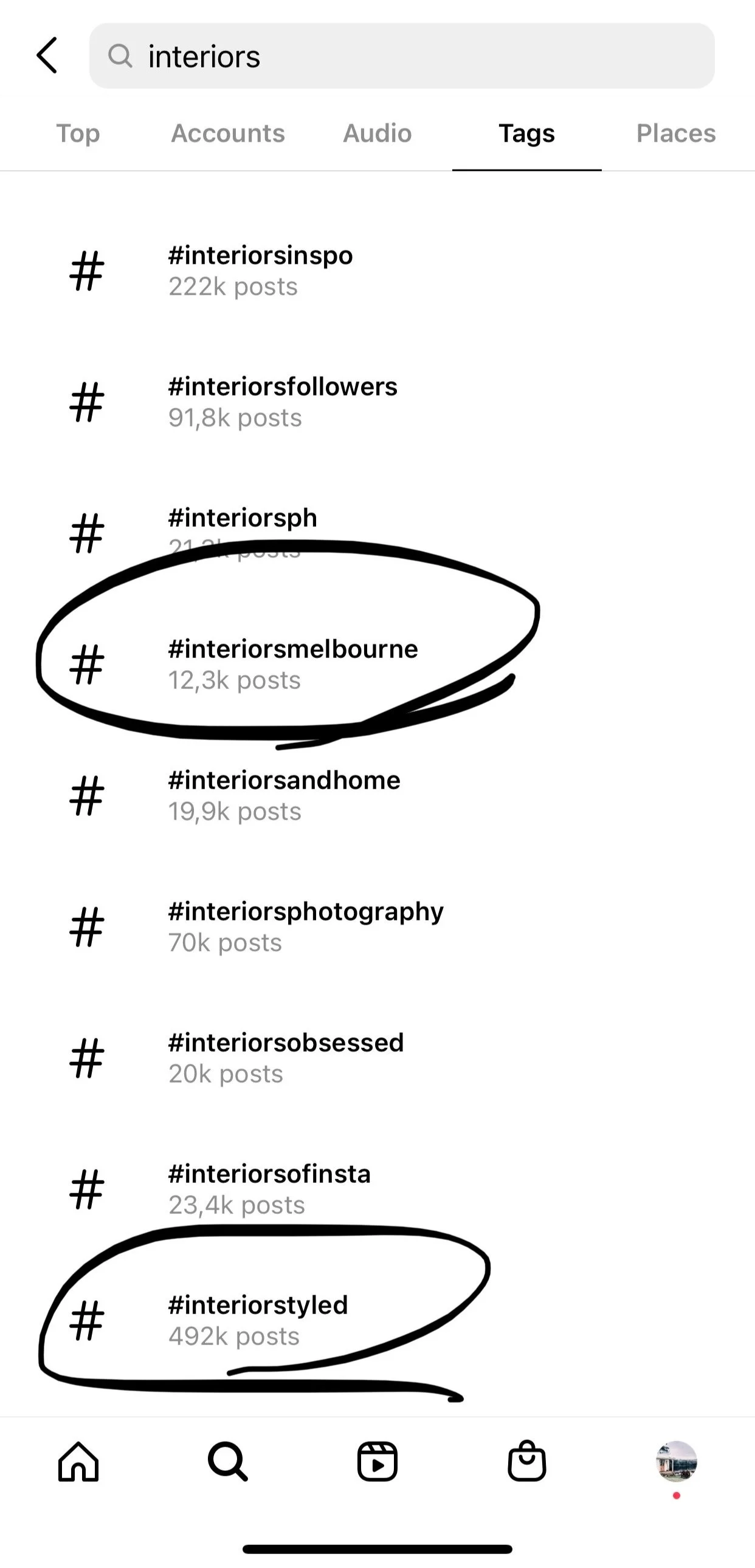

The above two examples show how you can use a keyword to search popular hashtags on Instagram. I like to use ones with lots of posts AND ones that are more niche and only have a few posts. The mix is good to connect you to new and dedicated audiences.
It’s a good idea to have a list of the hashtags you would like to use in the notes section of your phone, so you can easily copy and paste them to put into your posts. I like to use between 1-3 hashtags so as not to overdo it, and post these in the first comment of your post. If you’re new to Instagram, and you’ve found all this hashtag talk a little confusing, here’s a great guide to help you understand them, and how to use them – step by step.
Alliance Partnerships.
Lastly, but also just as importantly, is to consider alliance partnerships. Remember high school? Thank goodness for most of us taking this class that chapter of our lives is over. But if you can remember back that far, one of the first social lessons we all learnt, which is entirely relevant in our online world today is “cool by association” – whoever was friends with the cool kids at school was also cool, no matter what. That social stamp of approval meant instant street cred, and it still does.
How can we use this to our advantage in the social world? Well, if you’re just starting out, attaching yourself to brands or people who are doing well, and fit your story, is going to help you build your audience. You might consider teaming up with a linen company to shoot in your space and feature you, or if you are a creator, have some of your products in the shoots of a stylist or photographer who is doing really well. Perhaps you could team up with a local restaurant or maker that has a great online following and do a giveaway? Whatever you are doing, there are infinite creative ways to team up to work with people in your space doing well – and hopefully get the knock-on effect of their followers following you too!
Workbook Time. Reach for your workbook, and complete Question 8.3, now. This is about making notes on the four methods to grow your account, with your ideas of possibilities for each. Part of the work we do within both our schools, this one and The Hosting Masterclass, is one-one-one consultations with students to help them individually where their businesses or ideas feel a bit stuck or are failing to grow as hoped. 99.9999% of the time, if they fail to be where they hope to be, they have left out or shied away from growing their account using the steps above, which must become a constant and consistent practice, especially in your first few years online. I know it’s very scary putting yourself out there, but it does get easier the more you do it. If you are kind, polite and low pressure online, people out there will welcome you with open arms, just like they would in real life.
Lesson: Navigating The Online World
Before we race off to tell our stories and grow our accounts (well done for learning so much and giving it a go!), there are a few words of wisdom I want to impart, as you go forth and navigate the online world.
Firstly, I want to tell you it’s going to take time. Most of our students who follow our advice and principles take anywhere between six months and a year to start to gain traction. A lot of effort is put in at the start of your online journeys, but it does pay off and get far easier as you go, with followers starting to find you organically through friends of friends, or others talking about you. Slow down, work on your storytelling, enjoy growing your audience and connecting with others, and eventually you’ll get there. The best time to plant a tree was 10 years ago, the second best time is right now.
Secondly, like real life, sometimes you’ll run in to people who might make you feel uncomfortable in some way. It’s not common, but negative experiences with other people is an unavoidable fact of living. My advice is to never engage. There are a few ways to do this, so I’ll speak here about functionality if you are using Instagram. If you are using other platforms, you may need to do a bit of research but similar tools exist. If you open a DM that is unsettling in any way, use the unread function and don’t engage. If someone posts something also upsetting in any way on your posts or page, you can use the restrict function – which means no one else can see their comments on your posts. Engaging in any way such as blocking, commenting back, replying to a message will almost certainly inflame most situations. Disengaging usually dissipates things.
Thirdly, remember why you are online. To grow your work and your following around your art, creativity or business. Have boundaries about what you share – and what you don’t. For instance, there are parts of my life I openly share – my work, my students, my business, travel stories, my love for animals and family stories. There are parts that I do not, including my relationships, negative experiences I have had in my work world and things I am struggling with personally. There is an exercise in your workbook that will help you tease out for yourselves what is on the table to share, and what is not – I think this is a key exercise to keep close as you move forward with your storytelling in your new online world.
Lastly, I just want to congratulate you. Telling our stories and growing our audience online is scary for most. By slowing down – trusting this work and yourself and taking it step by step you will get there. I promise! Using the hashtag #principlesofstyle for your work will build a supportive community of people taking the same steps as yourself, and will help beyond your wildest dreams. Give it all a go, you’ll see!
Workbook Time. One last time for this chapter. Reach for your workbook, and complete Exercise 8.5, now.
“If we don’t change, we don’t grow. If we don’t grow, we are not really living. Growth demands a temporary surrender of security. It may mean a giving up of familiar but limiting patterns, safe but unrewarding work, values no longer believed in, relationships that have lost their meaning.
As Dostoevsky put it, ‘Taking a new step, uttering a new word, is what people fear most.’ The real fear should be of the opposite course.”
— Gail Sheehy.
08. Homework
Read: the theory of 1000 true fans. 1000 true fans is what we are all aiming to cultivate by the work in this chapter.
Do: Incredible things happen to our students via the connections they are making with each other. Make sure you are following the #poss and #thehostingmasterclass hashtags.
08. Community
Any work, or ideas you are posting related to this class, please use the hashtags #principlesofstyle and #poss08 so your fellow classmates can connect with you and continue to grow this community.